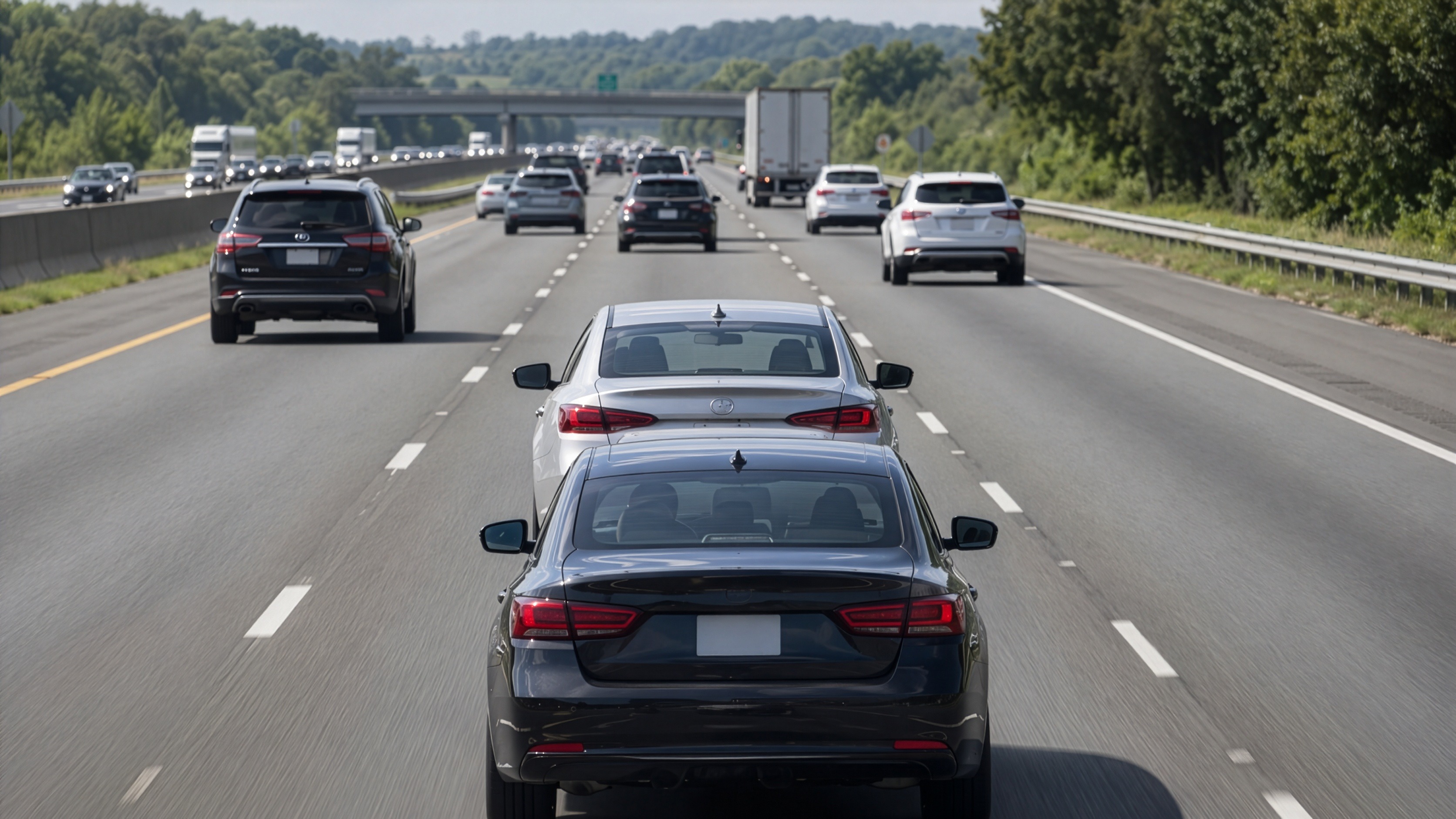
You look in your rearview mirror and another vehicle seems almost attached to your bumper.
You speed up a little. They stay there.
You slow down. They stay there.
Few driving behaviors make people uncomfortable as quickly as tailgating.
Following another vehicle too closely reduces reaction time, increases the chance of a rear-end collision, and can turn an ordinary traffic situation into an aggressive confrontation.
But why do drivers do it, and more importantly, what should you do when it happens to you?
What Is Tailgating?
Tailgating simply means following another vehicle too closely for the speed, traffic conditions, and roadway conditions.
The problem is not just the number of feet between two cars. What really matters is whether the following driver has enough time and distance to react if the vehicle ahead suddenly slows or stops.
Virginia DMV recommends maintaining a space cushion and using time-based following-distance rules to determine whether you are far enough behind the vehicle ahead.
Why Do People Tailgate?
There is not one single reason.
Some drivers tailgate intentionally. Others may not even realize they are doing it.
Common reasons include:
- impatience,
- trying to pressure another driver to move faster,
- anger or road rage,
- following traffic without paying attention to spacing,
- driving too fast for conditions,
- distraction,
- or simply developing the habit of following too closely.
Sometimes a driver believes that staying close to the car ahead will somehow make traffic move faster.
It usually does not.
Tailgating Gives You Less Time to React
Traffic can change in an instant.
The vehicle ahead may brake because of:
- an animal entering the road,
- a pedestrian,
- traffic suddenly stopping,
- road debris,
- a crash ahead,
- a changing traffic signal,
- or another vehicle cutting into the lane.
If you are following too closely, the time between noticing the problem and reaching the vehicle ahead may be extremely short.
Leaving more space gives you time to recognize the hazard, react, and brake normally instead of making a panic stop.
How Much Following Distance Should You Leave?
One of the easiest ways to judge following distance is by time rather than trying to estimate feet.
Pick a fixed object ahead, such as a sign, bridge, or light pole.
When the vehicle in front of you passes that object, begin counting.
If you reach the same point too quickly, increase the distance between the vehicles.
Virginia DMV advises drivers to use a two-, three-, and four-second approach depending on conditions, and its teen-driver guidance recommends keeping four seconds of following distance.
More space may be necessary when:
- roads are wet or icy,
- visibility is poor,
- traffic is heavy,
- you are following a motorcycle,
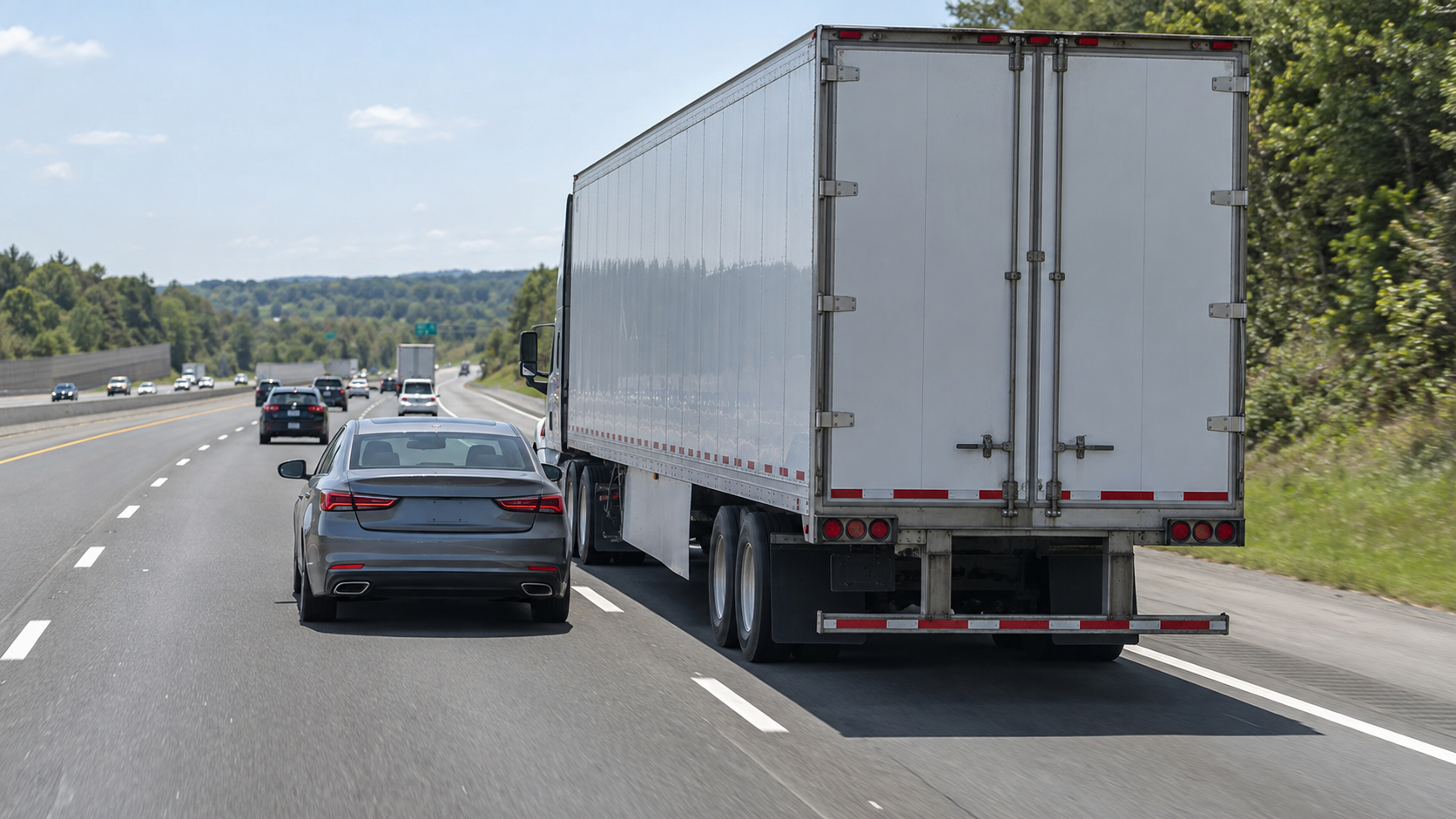
- you are behind a large truck,
- or conditions otherwise increase stopping distance.
What Should You Do If Someone Is Tailgating You?
The most important thing is to avoid turning the situation into a competition.
Do not try to teach the other driver a lesson.
Do not intentionally block them.
Do not make sudden moves just because you are angry.
If you can safely change lanes and allow the driver to pass, that is usually the simplest solution.
Virginia DMV specifically advises drivers who are being tailgated to move over when possible and allow the aggressive driver to pass. NHTSA gives similar advice when dealing with speeding or aggressive drivers.
Should You Speed Up?
Not simply because someone is following too closely.
Speeding up may only result in the same driver tailgating you at a higher speed.
Instead, maintain a predictable speed and look for a safe opportunity to let the driver go around you.
If you cannot move over immediately, increasing the space between your vehicle and the vehicle ahead can also help.
That extra space gives you room to slow gradually if traffic ahead stops, reducing the chance that you will need to brake suddenly with a tailgater behind you.
Do Not Brake-Check a Tailgater
Brake-checking is one of the worst ways to respond.
A brake check is when a driver intentionally hits the brakes to scare, punish, or warn the person following behind.
Even if the other driver is clearly following too closely, intentionally creating a sudden braking situation can make the danger much worse.
It may cause a crash, trigger road rage, or escalate an already aggressive encounter.
The goal should be to create distance from the aggressive driver, not provoke them.
What If You Are Already in the Right Lane?
Sometimes a driver will tailgate even when there is nowhere reasonable for you to move.
You may already be in the right lane, surrounded by traffic, or approaching an exit.
In that situation, stay predictable.
Avoid sudden braking or lane changes.
Maintain enough room ahead so that if traffic slows, you can reduce speed gradually rather than making a hard stop.
If another lane or safe turnout becomes available, letting the aggressive driver get ahead of you may remove the problem entirely.
What If the Driver Keeps Following You?
There is an important difference between someone briefly tailgating you and someone deliberately following or harassing you.
If you believe another driver is intentionally following you, do not drive directly to your home.
Virginia DMV advises drivers in this situation to contact law enforcement or drive to a police station rather than stopping to confront the other person.
If you need to call for help while driving, have a passenger make the call when possible or pull over somewhere safe before using your phone.
Tailgating Can Also Create Traffic Waves
Following too closely does more than increase crash risk.
It can also contribute to the stop-and-go traffic waves we discussed in Why Does Traffic Stop When There Isn't an Accident?
When drivers leave very little space, even a small brake application can force the vehicle behind them to brake harder.
That braking response can travel backward through traffic until vehicles farther behind are nearly stopping.
More following distance gives drivers room to absorb small speed changes without immediately hitting the brakes.
Sometimes You May Be the Tailgater Without Realizing It
Tailgating is not always aggressive.
Drivers can gradually creep closer to the vehicle ahead without noticing, especially during heavy traffic or long highway drives.
Ask yourself:
- Could I stop safely if the car ahead stopped suddenly?
- Am I staring at the bumper instead of looking farther down the road?
- Am I following closely because I am impatient?
- Would adding a little more space actually change my arrival time very much?
Often, backing off slightly makes driving calmer without meaningfully increasing travel time.
The Bottom Line
Tailgating does not make the vehicle ahead disappear.
It does not make traffic move faster.
What it does is reduce reaction time and increase tension between drivers.
If someone is tailgating you, avoid the temptation to fight for control of the road.
Stay predictable, give yourself room ahead, and let the driver pass when it is safe to do so.
And if you find yourself following another vehicle too closely, back off.
A few extra seconds of space can make the difference between simply slowing down and becoming part of a crash.
Comments
No comments yet. Be the first to join the discussion.
Leave a Comment
Your email will not be displayed publicly. Comments are reviewed before publication.