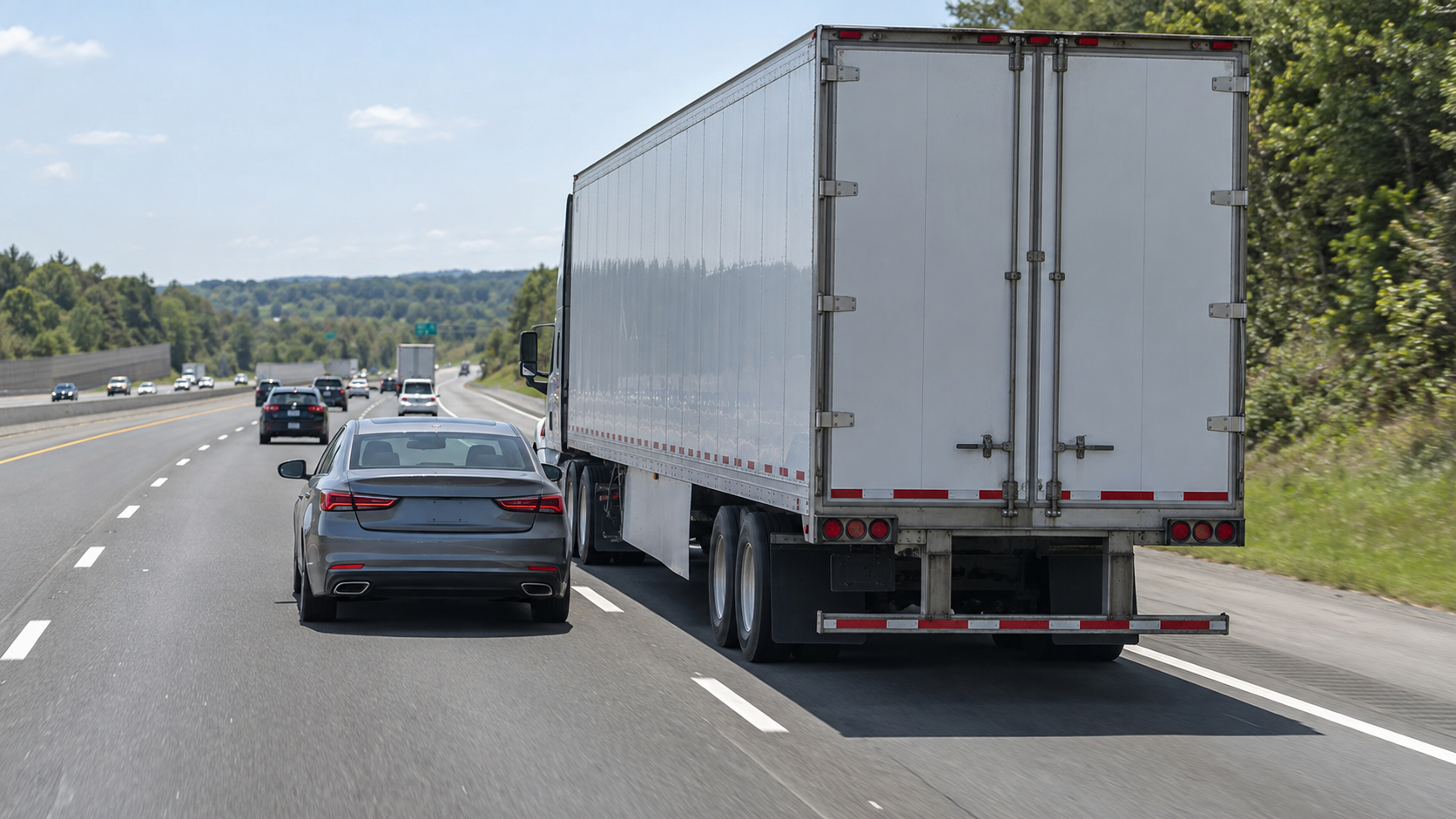
Most drivers know they should give large trucks extra room, but one of the most common mistakes on the highway is surprisingly simple: driving beside an 18-wheeler for too long.
You may be traveling at the same speed, waiting for an opening, or simply not thinking much about the truck next to you. But remaining alongside a tractor-trailer can put your vehicle in a place where the truck driver may have difficulty seeing you and where you have fewer options if something suddenly goes wrong.
The safer approach is generally straightforward: if you are going to pass a large truck, pass when conditions allow and avoid lingering beside it unnecessarily.
Large Trucks Have Much Bigger Blind Spots
Passenger vehicles have blind spots, but tractor-trailers have significantly larger areas around them where another vehicle may be difficult or impossible for the truck driver to see.
The Federal Motor Carrier Safety Administration refers to these areas as a truck's “No-Zones.” They can exist along both sides of the truck, directly behind it, and immediately in front of it.
A useful rule is this: if you cannot see the truck driver in the truck's side mirror, there is a good chance the driver cannot see you.
That does not mean the truck driver is not paying attention. It is simply a limitation created by the size and shape of the vehicle.
Why the Right Side of a Truck Is Especially Important
The passenger side of a tractor-trailer can contain a very large blind spot.
A car traveling beside the trailer may disappear from the driver's view for a period of time. If the truck needs to change lanes, avoid debris, or move because another lane is ending, the driver may not immediately know that a smaller vehicle is occupying that space.
This is one reason drivers should avoid cruising next to a truck simply because both vehicles happen to be traveling at the same speed.
Don't Match the Truck's Speed for Miles
You've probably seen this situation:
A car begins passing a tractor-trailer but then slows down until both vehicles are traveling nearly side-by-side.
The car may remain there for several minutes.
That creates two problems.
First, the car remains close to the truck's blind-spot area much longer than necessary.
Second, it may block traffic behind it from completing their own passes.
If traffic, weather, and the speed limit allow you to pass safely, complete the pass rather than remaining alongside the trailer.
Give Yourself Somewhere to Go
One of the most important ideas in defensive driving is maintaining an escape route.
When you are directly beside a tractor-trailer, your choices become limited.
If something happens ahead of you, you may have:
- a truck immediately beside you,
- a guardrail or shoulder on the other side,
- traffic behind you,
- and very little time to react.
Creating space around your vehicle gives you more options when another driver makes a mistake or road conditions suddenly change.
Large Trucks Need Much More Room to Stop
Large trucks are extremely heavy compared with passenger vehicles, and that weight affects how quickly they can stop.
FMCSA warns drivers that large trucks and buses require significantly more stopping distance than passenger vehicles and can require extremely long distances to stop from highway speeds.
This matters especially when moving back into the lane in front of a truck.
Passing the truck and immediately cutting a few feet in front of its bumper removes the safety space the truck driver needs.
After passing, wait until you can clearly see the truck in your rearview mirror before moving back into the lane.
A Truck May Need to Move Suddenly
Large trucks are not perfectly stationary within their lane.
Drivers may need to adjust because of:
- wind,
- road debris,
- construction,
- merging traffic,
- potholes,
- narrow lanes,
- or another vehicle entering their space.
Even a relatively small movement by a tractor-trailer can feel significant when your car is only a few feet away.
Leaving space gives both drivers more room to react.
Be Careful Around Truck Tires
Another reason not to remain beside a tractor-trailer is the possibility of a tire failure.
Large truck tires carry enormous loads. Although tire failures are not something that happens constantly, pieces of tire can separate when a failure occurs.
If you are directly beside the trailer at that moment, you have very little room or time to respond.
This does not mean you should be afraid to pass trucks. It simply means there is little benefit to remaining beside one longer than necessary.
Never Squeeze Beside a Truck Making a Turn
Large trucks require much more room to turn than passenger vehicles.
A truck making a right turn may initially move left to create enough room for the trailer to clear the corner.
That does not mean the space on the truck's right side is an open lane for another vehicle to squeeze through.
FMCSA specifically advises drivers to give trucks and buses additional space for wide turns and to wait for them to finish turning.
If you see a truck signaling for a turn, stay back and let the entire vehicle complete the maneuver.
How to Pass an 18-Wheeler More Safely
Passing a truck does not need to be complicated.
When road conditions allow:
- make sure there is enough clear space ahead,
- signal before changing lanes,
- avoid entering the truck's blind spot unnecessarily,
- maintain a predictable speed while passing,
- avoid hanging beside the trailer,
- and do not move back in front of the truck too closely.
FMCSA recommends passing large trucks safely and promptly rather than remaining in their blind spots.
What If You Cannot Complete the Pass?
Sometimes traffic prevents you from passing immediately.
Maybe another vehicle is blocking the lane ahead, or traffic begins slowing while you are beside the truck.
In that situation, do not force the pass.
If practical and safe, allowing a little more following distance can move your vehicle away from the truck's blind-spot area until there is enough room to pass normally.
The goal is not to race the truck. The goal is to avoid unnecessarily remaining beside it.
Truck Drivers Need Cooperation Too
Sharing the road safely is a two-way responsibility.
Professional truck drivers are responsible for checking mirrors, signaling, maintaining their lane, and operating safely around smaller vehicles.
At the same time, passenger-vehicle drivers can make the situation safer by understanding that a tractor-trailer simply cannot see, turn, accelerate, or stop exactly like a car.
FMCSA highlights three of the biggest differences: large blind spots, longer stopping distances, and wide turns.
The Bottom Line
You do not need to avoid trucks on the highway.
You just need to respect the space they require.
If you are passing an 18-wheeler, pass when it is safe and avoid remaining directly beside the truck longer than necessary.
If you are following one, leave room.
If a truck is turning, stay back.
And remember: the few seconds you might save by squeezing into a small opening are rarely worth giving up the safety space around your vehicle.
The best place beside an 18-wheeler is usually a temporary one.
Comments
No comments yet. Be the first to join the discussion.
Leave a Comment
Your email will not be displayed publicly. Comments are reviewed before publication.