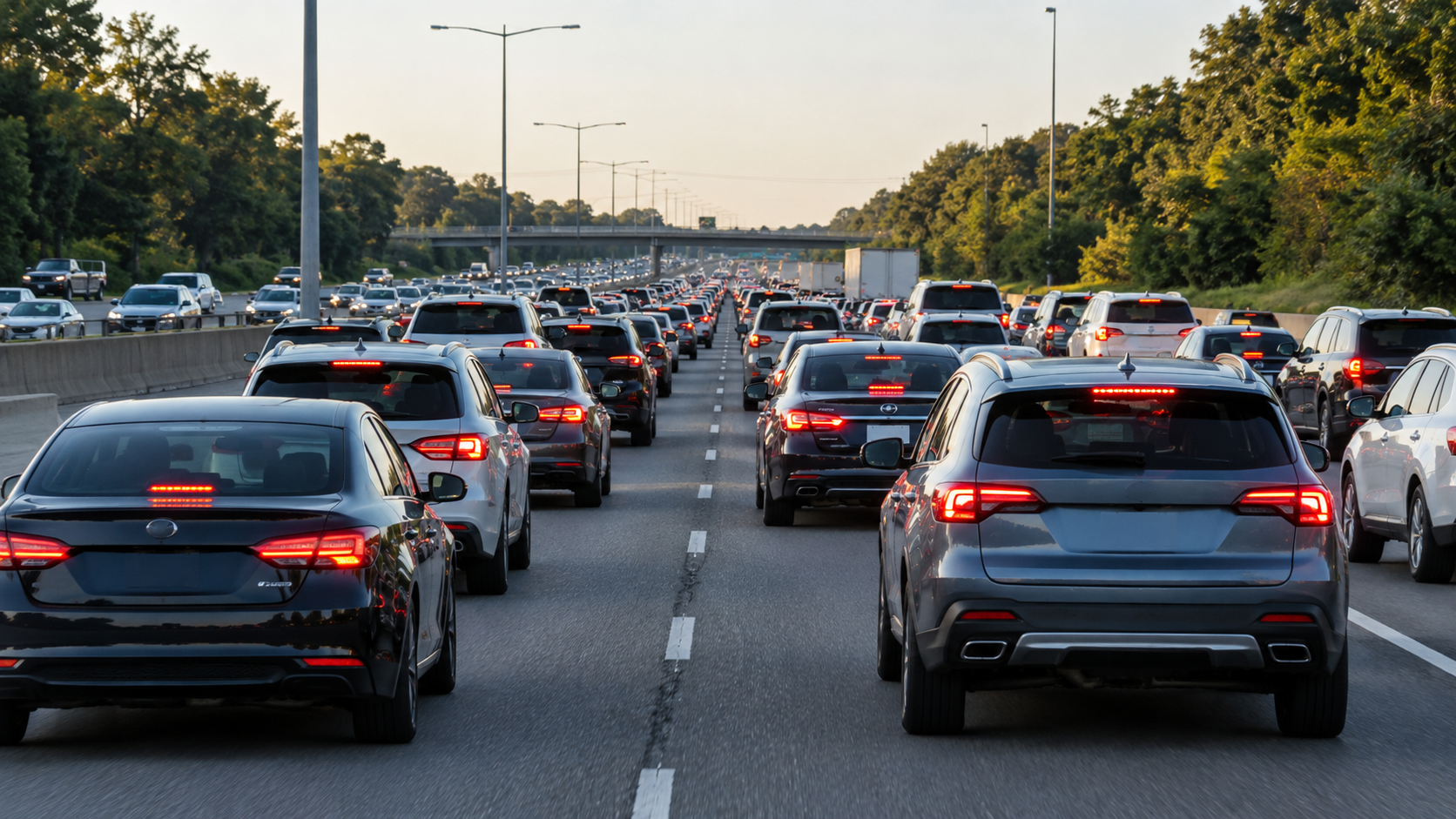
You are driving down the highway at a steady speed when traffic suddenly begins to slow.
Brake lights appear everywhere.
Cars come almost to a stop.
You assume there must be an accident, construction zone, disabled vehicle, or police activity ahead.
Then, a few minutes later, traffic starts moving again.
You pass the point where you expected to find the problem and there is... nothing.
No crash. No lane closure. No obvious reason for the slowdown.
What happened?
You probably experienced what traffic engineers often call a phantom traffic jam or traffic shockwave.
What Is a Phantom Traffic Jam?
A phantom traffic jam is a slowdown that develops without a permanent physical obstruction such as an accident, construction zone, or closed lane.
Instead, the congestion can begin with something as small as one driver tapping the brakes.
That small change in speed gets passed from one vehicle to the next.
Each driver reacts slightly differently, and the slowdown can grow as it moves backward through traffic.
The strange part is that the original cause may be long gone by the time you reach the location where traffic slowed.
How Can One Driver Cause a Traffic Jam?
Imagine a line of vehicles traveling at 65 mph.
The first driver slows briefly to 60 mph.
The driver behind notices the brake lights and slows to 57 mph.
The next driver reacts a little later and slows to 52 mph.
Another driver brakes harder and drops to 45 mph.
Farther back, someone may have to slow nearly to a stop.
The original driver may already be back at 65 mph, but the braking wave continues moving backward through traffic.
This is why the slowdown can seem to appear from nowhere.
Traffic Waves Move Backward
The vehicles are moving forward, but the congestion wave can move backward through the traffic stream.
That sounds strange until you think about a stadium wave.
Each person stands up and sits down in place, but the wave itself moves around the stadium.
Traffic can behave in a similar way.
Each driver slows and accelerates, while the point of congestion travels backward through the line of vehicles.
Following Too Closely Makes It Worse
Short following distances are one of the biggest reasons small speed changes turn into larger traffic waves.
If you are following closely and the vehicle ahead slows slightly, you have less room to respond gradually.
You may need to brake harder.
The driver behind you then reacts to your stronger braking and may brake even harder.
That creates a chain reaction.
More space between vehicles gives drivers room to absorb small speed changes without turning every minor slowdown into a major braking event.
Why Drivers Overreact to Brake Lights
Drivers do not know why the vehicle ahead is braking.
It could be:
- a sudden hazard,
- a vehicle entering the lane,
- a curve in the road,
- an animal,
- debris,
- or simply someone adjusting speed.
Because the reason is unknown, drivers often respond conservatively.
That means a small brake application farther ahead can produce a much larger reaction several vehicles later.
Lane Changes Can Trigger the Same Effect
Frequent lane changes can also create traffic waves.
Suppose a driver moves into a small gap.
The vehicle behind them now has less following distance and taps the brakes.
The next driver brakes harder.
Several vehicles farther back, traffic may nearly stop.
The lane-changing driver continues down the road and may never realize that the maneuver created a braking wave behind them.
Merging Creates Natural Bottlenecks
On-ramps are another common source of unexplained traffic slowdowns.
When vehicles enter a highway, existing traffic must adjust.
Drivers may:
- slow down to create space,
- move into another lane,
- accelerate to get ahead of merging traffic,
- or brake because another driver merged into a small gap.
Each of those actions affects the vehicles behind.
When traffic volume is already high, a busy merge can push the roadway past the point where traffic flows smoothly.
That is one reason congestion often appears near interchanges even when there is no accident.
Why Does Traffic Suddenly Start Moving Again?
Because the cause may have been temporary.
Once the traffic wave passes, there may be nothing left to see.
The driver who originally slowed may be miles ahead.
The merging vehicles may already be gone.
The lane change that triggered the braking may have happened several minutes earlier.
You only experience the remaining wave.
Human Reaction Time Matters
Drivers do not respond instantly.
There is always a delay between seeing something happen and reacting to it.
During that delay, your vehicle continues moving.
Then there is another delay before the driver behind you reacts.
Multiply that across dozens or hundreds of vehicles and small differences in reaction time can create large changes in traffic speed.
Acceleration Is Usually Slower Than Braking
There is another reason traffic takes so long to recover.
Vehicles can slow down very quickly.
But traffic usually accelerates again much more gradually.
When a line of vehicles is stopped, the first car begins moving.
Then the second.
Then the third.
Each driver waits for space to open before accelerating.
This creates a delay that moves backward through the queue.
That is why traffic can remain slow even after the original cause is gone.
Rubbernecking Can Create Traffic Without Blocking a Lane
Drivers often slow down simply to look at something.
An accident may be on the opposite side of the highway.
Emergency lights may be visible.
A vehicle may be stopped on the shoulder.
Nothing is physically blocking your lane, but enough drivers slowing to look can create a traffic wave.
This is sometimes called rubbernecking.
The congestion may continue long after the unusual event is no longer visible.
Hills and Curves Can Cause Mystery Slowdowns
Road design also affects traffic flow.
Drivers often slow slightly when:
- approaching a hill,
- driving through a sharp curve,
- entering a tunnel,
- crossing a bridge,
- or traveling through a narrow section of roadway.
One driver slowing a few miles per hour may not matter when traffic is light.
But when traffic volume is near the road's capacity, that small reduction can be enough to start a larger wave.
Why Heavy Traffic Is So Unstable
When there are only a few vehicles on the road, drivers have plenty of room to absorb small changes.
When the highway is nearly full, there is very little spare space.
One driver brakes.
Another changes lanes.
A group enters from an on-ramp.
Suddenly the traffic stream cannot absorb the disturbance smoothly.
That is when a small event can turn into a major slowdown.
Can One Slow Driver Cause a Traffic Jam?
Sometimes.
A slow vehicle can create a moving bottleneck, especially if it occupies a lane that other vehicles are trying to use for passing.
Traffic may begin changing lanes around that vehicle, which creates more interactions and braking.
This connects directly to left-lane behavior.
For more on that, see Why Do People Drive Slowly in the Left Lane?
Can Bad Merging Cause Phantom Traffic?
Yes.
Merging works best when drivers make predictable speed adjustments and leave enough room for vehicles to enter.
When drivers accelerate to block a merge, force into tiny gaps, or brake suddenly at the last moment, the disruption spreads behind them.
During heavy congestion, a properly managed zipper merge can help organize traffic approaching a lane reduction.
See What Is a Zipper Merge — and Are You Supposed to Wait Until the Lane Ends?
Does Changing Lanes Help You Escape the Traffic?
Usually less than people think.
When traffic is moving in waves, one lane may temporarily move faster than another.
A driver changes lanes to take advantage of it.
Then the new lane slows and the old lane begins moving.
The driver changes again.
Repeated lane changes may gain a few vehicle lengths, but they also create additional braking and reduce gaps for everyone else.
In dense traffic, constantly chasing the fastest lane can contribute to the instability that creates the slowdown.
Why Leaving Space Can Actually Help Traffic
Drivers sometimes worry that leaving a larger gap means someone will simply move into it.
But a reasonable following distance gives you more control over how you react.
If the vehicle ahead slows by 5 mph, you may be able to ease off the accelerator instead of immediately hitting the brakes.
That smoother response reduces the chance that the driver behind you will need to brake sharply.
In that sense, a little extra space can act like a shock absorber for traffic.
What Can Drivers Do to Reduce Phantom Traffic Jams?
No individual driver can eliminate congestion, but driving behavior matters.
Helpful habits include:
- maintaining a reasonable following distance,
- avoiding unnecessary braking,
- looking farther ahead instead of only at the vehicle directly in front,
- accelerating smoothly,
- avoiding unnecessary lane changes,
- creating space for merging traffic,
- using the proper lane for your speed and situation,
- and avoiding distractions that cause delayed reactions.
What About Adaptive Cruise Control?
Modern vehicles increasingly use adaptive cruise control to maintain distance from traffic ahead.
In theory, smoother automated speed adjustments can help reduce some of the sudden braking that contributes to traffic waves.
But the result depends on how the system is designed, the following distance selected, road conditions, and how surrounding drivers behave.
Technology can help, but predictable driving still matters.
Why Does Traffic Sometimes Stop in the Same Place Every Day?
If congestion repeatedly appears at the same location, there is probably an underlying bottleneck.
Common examples include:
- a major on-ramp,
- a lane reduction,
- a steep hill,
- a bridge,
- a tunnel,
- a sharp curve,
- or a busy interchange.
The road may work perfectly when traffic volume is low.
But during rush hour, the number of vehicles approaches or exceeds what that section can handle smoothly.
Once that happens, even a small disturbance can trigger recurring congestion.
So Why Did Traffic Stop If Nothing Happened?
Something probably did happen.
It just may not have been an accident.
Someone tapped the brakes.
A vehicle changed lanes.
Traffic merged from a ramp.
A driver followed too closely.
A truck slowed on a hill.
Someone looked at flashing lights on the opposite side of the highway.
Each event may seem insignificant by itself.
But when traffic is dense, those small disturbances can travel backward through hundreds of vehicles.
By the time you reach the place where you expected to find the problem, the original cause may be long gone.
The Next Time Traffic Stops for “No Reason”
Instead of immediately assuming there must be a crash ahead, watch how traffic is behaving.
You may be watching a traffic wave pass through the highway in real time.
Leave enough space to react smoothly, avoid unnecessary lane changes, and try not to add another hard-braking event to the wave.
Sometimes the best way to help traffic move is simply to drive predictably.