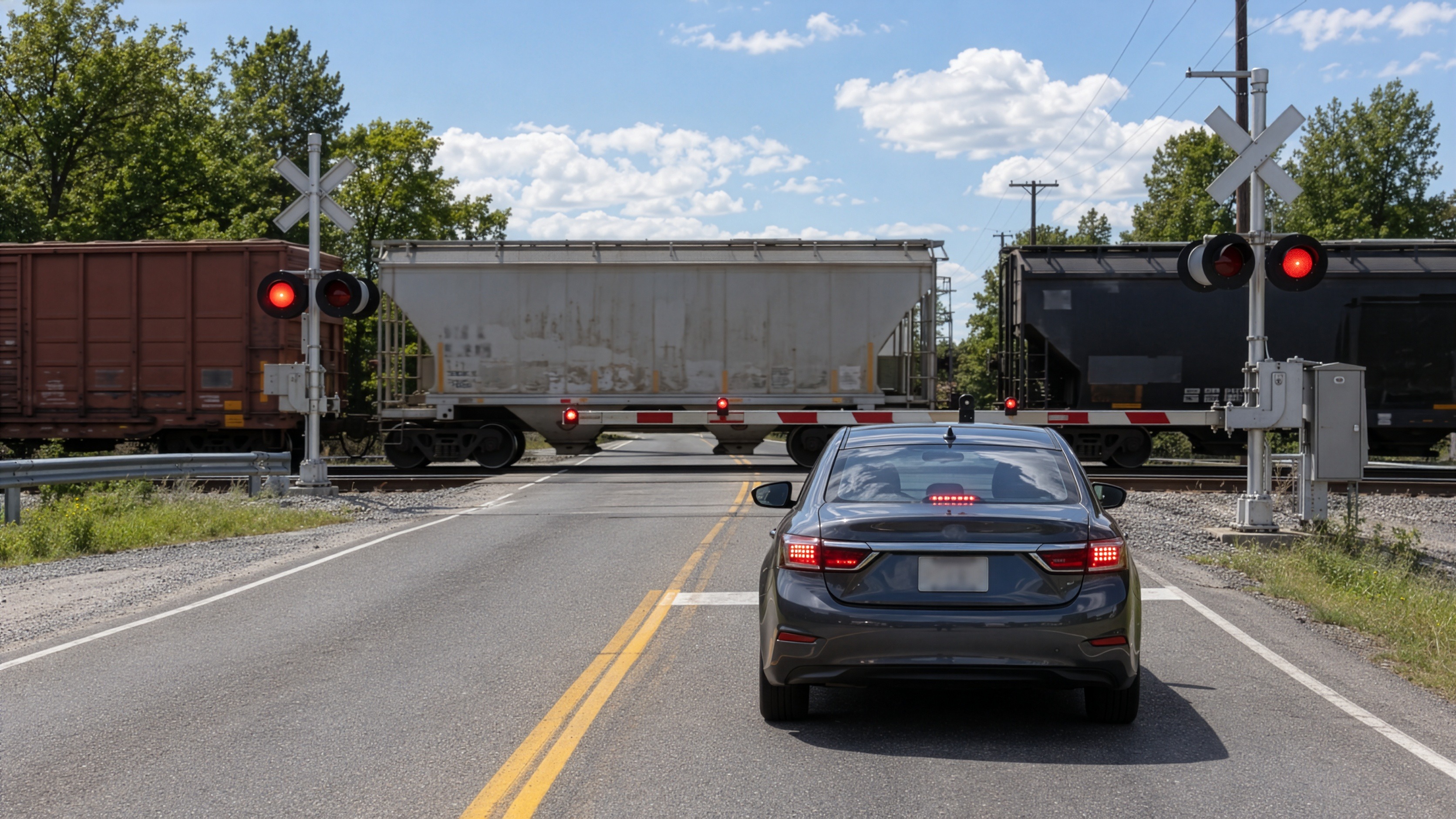
Most railroad crossings are routine.
You slow down, look around, cross the tracks, and continue driving.
But railroad crossings are different from ordinary intersections in one very important way:
A train cannot stop, turn, or avoid you the way another vehicle can.
That means drivers need to treat every crossing with extra attention, even when the signals are not flashing and the gates are up.
Always Be Prepared for a Train
When approaching railroad tracks, do not assume the crossing is clear simply because you do not immediately see or hear a train.
Trains can approach from either direction, and visibility may be limited by:
- buildings,
- trees,
- curves in the tracks,
- parked rail cars,
- weather,
- or surrounding traffic.
Slow down enough to observe the crossing and be prepared to stop when required.
When Must You Stop?
Virginia law requires drivers to obey railroad warning signals.
Outside cities and towns, drivers must stop when:
- a visible signal warns that a train is approaching,
- a crossing gate is lowered,
- a flagger signals the approach or passage of a train,
- a train gives an audible warning,
- or a train is plainly visible and close enough to create a hazard.
When a stop is required, Virginia law specifies stopping within 50 feet but not less than 15 feet from the nearest rail.
Do not proceed until the crossing can be made safely.
Never Drive Around a Lowered Gate
A lowered crossing gate is not a suggestion.
Do not drive around, under, or through a gate while it is closed, lowering, or rising.
Virginia law specifically prohibits driving through, around, or under a railroad crossing gate or barrier while it is closed or while it is being opened or closed.
Even if you do not immediately see a train, the warning system may be responding to one that is approaching quickly.
Do Not Enter the Crossing Unless You Can Clear It
This is one of the most important railroad-crossing rules.
Before driving onto the tracks, make sure there is enough room on the other side for your entire vehicle.
Do not enter the crossing if traffic is backed up and there is a chance you could become trapped on the rails.
Virginia DMV specifically advises drivers never to begin crossing unless they can clear the tracks completely.
Waiting before the tracks may be inconvenient.
Stopping on the tracks because traffic ahead has nowhere to go is far more dangerous.
Do Not Follow the Car Ahead Onto the Tracks
Traffic can make drivers focus more on the vehicle ahead than on the railroad crossing itself.
If the car ahead moves forward, that does not automatically mean there is enough room for you.
Look beyond that vehicle.
Ask yourself whether your entire vehicle will fit on the far side of the tracks.
If the answer is not clearly yes, stay where you are.
What If the Lights Start Flashing While You Are Crossing?
If you are already on the tracks when the warning system activates, keep moving and clear the crossing.
Do not stop on the rails.
Do not reverse unless you absolutely must and doing so is clearly safer.
The priority is to get completely off the tracks as quickly and safely as possible.
Why You Should Never Try to Beat a Train
Drivers sometimes underestimate how quickly a train is approaching.
A train can appear farther away or slower than it really is because of its size and the long, open view along the tracks.
Trying to save a few seconds by crossing before an approaching train is never worth the risk.
If there is any doubt, wait.
What If Your Vehicle Stalls on the Tracks?
If your vehicle becomes disabled on a railroad crossing, do not stay inside trying to restart it indefinitely.
Get everyone out of the vehicle immediately and move away from the tracks.
If a train is approaching, Virginia DMV advises moving diagonally away from the tracks in the direction of the approaching train.
This may sound counterintuitive, but it helps move you away from debris that could be pushed forward if the train strikes the vehicle.
Once you are safely away from the tracks, call for help.
Look for the Blue Emergency Notification Sign
Many railroad crossings have a blue emergency notification sign mounted near the crossing equipment.
This sign typically includes:
- an emergency phone number,
- the railroad's name,
- and a crossing identification number.
If a vehicle is stuck on the tracks, the crossing equipment is damaged, or another dangerous condition exists, use the number on that sign.
The crossing number tells the railroad exactly where the problem is located so approaching rail traffic can be warned or stopped when possible.
Do Not Rely Only on the Gates and Lights
Automatic signals are important safety devices, but drivers should still look and listen.
Equipment can malfunction.
A crossing may not have gates at all.
Some crossings may only have signs.
When approaching the tracks, stay alert and visually check both directions whenever conditions allow.
Why School Buses Stop at Railroad Crossings
You may notice school buses stopping at railroad crossings even when the lights are not flashing.
That is intentional.
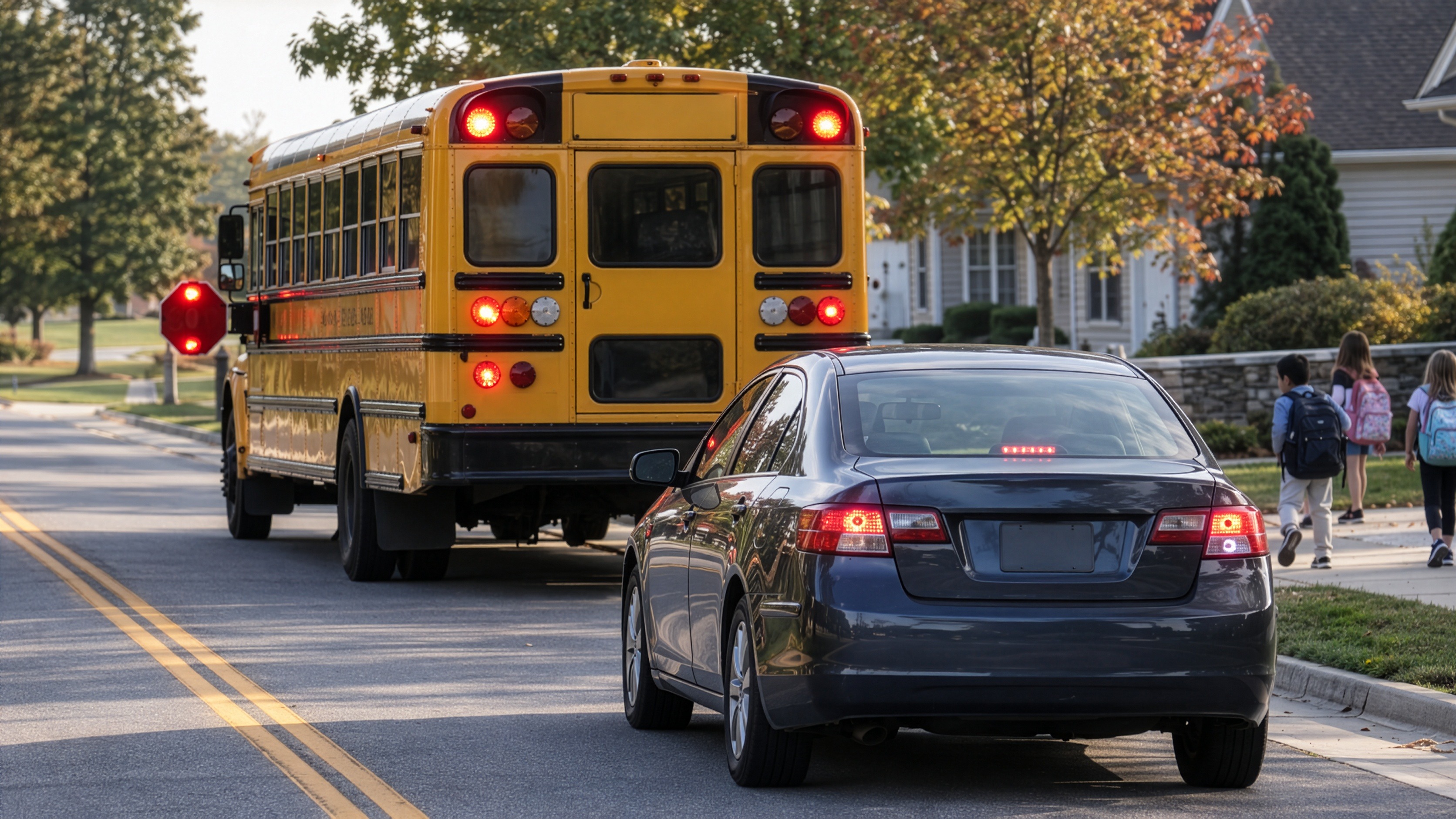
Virginia law requires school buses to stop before crossing railroad tracks, with limited exceptions when traffic is specifically directed to proceed.
Certain other vehicles carrying passengers for hire or hazardous materials may also have special stopping requirements.
If you are driving behind one of these vehicles, expect it to stop.
Do Not Pass Carelessly at a Railroad Crossing
A railroad crossing is not a good place to become impatient with a slower vehicle.
Virginia law can treat certain passing maneuvers at railroad grade crossings as reckless driving.
Even where passing may be permitted under a particular road configuration, the safer approach is to avoid unnecessary lane changes and concentrate on the crossing itself.
Watch for Motorcycles and Bicycles
Railroad tracks can create additional problems for motorcycles and bicycles.
The rail surface can be slippery, especially when wet, and crossing at an awkward angle can affect stability.
Give smaller road users extra room and do not crowd them while crossing the tracks.
Do Not Stop Too Close to the Tracks
When traffic stops near a railroad crossing, leave enough space between your vehicle and the rails.
Large trains can extend beyond the width of the tracks themselves.
Stopping well back also gives you additional room if traffic patterns change unexpectedly.
What If a Train Has Just Passed?
Do not immediately assume the crossing is clear.
There may be another train approaching on a second track.
Wait until the warning devices stop, the gates are fully raised, and you can clearly determine that the crossing is safe before proceeding.
Railroad Crossings Require Patience
Most of the mistakes drivers make at railroad crossings come from impatience.
They:
- drive around gates,
- follow traffic onto blocked tracks,
- try to beat an approaching train,
- or move before the warning system has completely cleared.
A train may delay you for a few minutes.
That inconvenience is insignificant compared with the risk of entering the crossing at the wrong time.
The Bottom Line
Approach railroad crossings with enough speed and distance to stop safely.
Obey the signals and gates.
Never drive onto the tracks unless you know you can clear them completely.
If your vehicle becomes stuck on the tracks, get everyone out immediately and move to safety before calling for help.
And never try to race a train through a crossing.
At a railroad crossing, patience is not just courtesy. It can save your life.
Comments
No comments yet. Be the first to join the discussion.
Leave a Comment
Your email will not be displayed publicly. Comments are reviewed before publication.