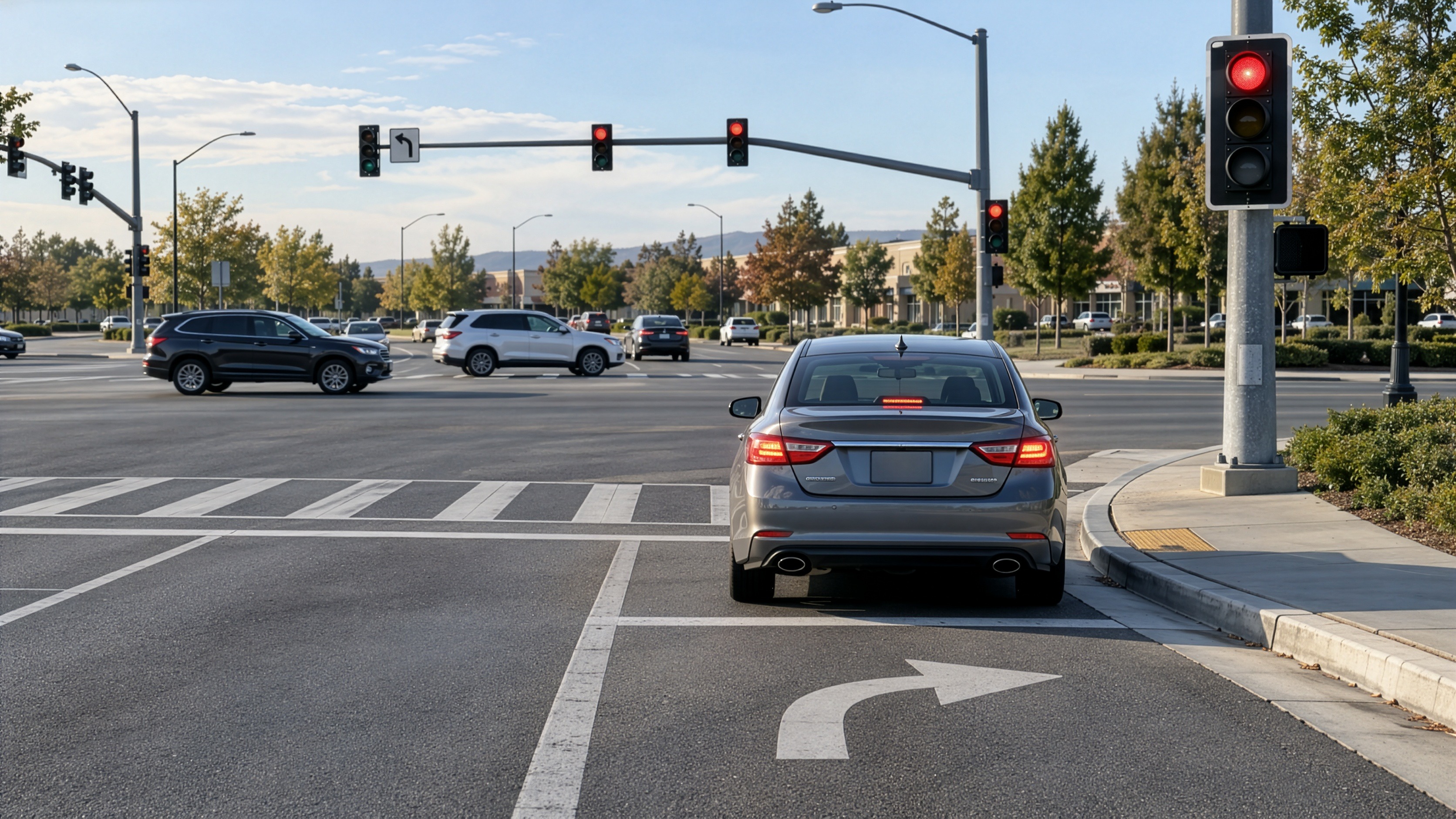
You pull up to a red light and need to make a right turn.
The road looks clear, so can you just slow down, check traffic, and turn?
No.
In Virginia, a right turn on a steady red circular light is generally allowed only after you come to a complete stop, unless a sign or traffic-control device prohibits the turn.
And even when the turn is permitted, you still have to yield to pedestrians and traffic that already has the right-of-way.
A red light is not a yield sign.
You Must Stop Before Turning Right on Red
One of the most common mistakes drivers make is treating a right turn on red like a rolling yield.
They approach the intersection, slow down, glance left, and continue through the turn without ever actually stopping.
That is not how the rule works.
Before turning right on a steady red light, the vehicle must come to a complete stop.
After stopping, the driver can determine whether the turn is permitted and whether it can be made safely.
When Can You Turn Right on Red?
In Virginia, a driver facing a steady circular red signal may generally turn right after stopping when:
- there is no sign prohibiting the turn,
- the signal is not a red right arrow that requires the driver to remain stopped,
- the driver has come to a complete stop,
- the intersection is clear enough to enter safely,
- pedestrians have been given the right-of-way,
- and approaching traffic has been given the right-of-way.
The important word is may.
You are permitted to turn when it is safe. You are not required to turn simply because right on red is allowed.
When Is Right on Red Not Allowed?
The most obvious situation is when you see a sign that says:
No Turn on Red.
When that sign is posted, remain stopped until the traffic signal permits your movement.
Virginia law also treats a steady red arrow differently from a normal circular red signal.
If you are facing a steady red arrow pointing right, you generally must remain stopped until a signal allows you to proceed, unless another traffic-control device specifically permits the turn.
A Red Light Does Not Give You the Right-of-Way
Even when turning right on red is legal, vehicles moving through the intersection on a green signal generally have priority over the vehicle entering from the red light.
That means you should not pull into the intersection and expect approaching traffic to slow down for you.
The same applies to pedestrians who are lawfully using the adjacent crosswalk.
Your turn should happen only after there is enough room to complete it without interfering with traffic or pedestrians that already have the right-of-way.
Watch the Crosswalk Before Looking Left
There is a common pattern at right turns on red.
The driver stops — or almost stops — and immediately turns their head to the left to look for a gap in traffic.
While looking left, the vehicle begins creeping forward.
The problem is that a pedestrian or cyclist may be directly in front of the vehicle.
Before concentrating on traffic coming from the left, check the crosswalk and the area immediately around your vehicle.
Then check approaching traffic.
Before actually making the turn, check the crosswalk again.
Pedestrians Can Be Easy to Miss
A pedestrian does not need to be directly in front of your hood to matter.
Someone may be:
- entering the crosswalk from your right,
- crossing from the opposite side,
- walking behind another vehicle,
- pushing a stroller,
- using a wheelchair,
- or moving quickly on a bicycle or other permitted device.
At busy intersections, drivers can become so focused on finding a gap in vehicle traffic that they stop scanning for people.
That is exactly when extra attention is needed.
Don't Let the Driver Behind You Pressure You
You are stopped at a red light waiting to turn right.
The driver behind you honks.
Maybe they can see something you cannot. Maybe they think the gap is large enough. Maybe they are simply impatient.
None of that changes your responsibility.
If you cannot clearly determine that the turn is safe, stay stopped.
The driver behind you does not have your view of the intersection and will not be making the decision for you.
You Are Not Required to Turn Right on Red
This is something many drivers forget.
Permission to turn right on red does not mean you must make the turn.
You may have a limited view because of:
- a large truck beside you,
- parked vehicles,
- construction equipment,
- vegetation,
- a building near the corner,
- heavy traffic,
- or poor weather.
If you cannot see well enough to make the turn safely, waiting for the green light is a perfectly reasonable choice.
Be Careful When a Large Vehicle Blocks Your View
Suppose a large SUV, delivery truck, or tractor-trailer is stopped in the lane to your left.
You may be unable to see approaching traffic beyond that vehicle.
Do not assume the road is clear simply because the vehicle next to you is not moving.
It may be waiting for another vehicle, a pedestrian, or something else you cannot see.
If necessary, remain stopped until your view improves.
Watch for Motorcycles and Bicycles
Smaller road users can be particularly difficult to notice when looking through busy traffic.
A motorcycle can be hidden behind another vehicle and appear much closer than expected once that vehicle passes.
Bicycles can also approach from areas drivers may not immediately check, especially near intersections with bike lanes or crosswalks.
Virginia DMV specifically reminds drivers making turns on red to look for less visible road users such as motorcycles, bicycles, and mopeds.
What About a Red Arrow?
A red arrow is not the same as a circular red light.
Under Virginia law, a driver facing a steady red arrow must generally remain stopped until a signal permitting movement is displayed, unless a traffic-control device specifically permits the turn.
This distinction is important because drivers sometimes assume that every red signal allows the same right-turn rule.
It does not.
What About Turning Left on Red?
Virginia also has a less commonly used rule involving left turns on red.
A driver on a one-way road may generally make a left turn on red onto another one-way road after coming to a complete stop, provided the turn is not prohibited and the driver yields as required.
A steady red left arrow has additional restrictions similar to a red right arrow.
This situation is far less common than a right turn on red, but it is another reason drivers should pay attention to the specific signal and road configuration instead of relying on habit.
Don't Confuse an Open Lane With a Safe Turn
You may see an approaching vehicle traveling in the far lane and think:
"My lane is empty, so I can go."
That can be risky.
The approaching vehicle could change lanes while entering the intersection.
Another vehicle could be hidden behind it.
A motorcycle might be difficult to see.
A safer decision considers the entire traffic situation rather than simply whether one lane appears open.
Right on Red in Heavy Traffic
Right turns on red can also cause problems when traffic on the road you are entering is backed up.
Do not enter the intersection unless there is actually enough room for your vehicle.
Turning into stopped traffic and becoming trapped in the intersection can interfere with cross traffic when the signal changes.
Waiting through another signal cycle is usually better than blocking an intersection.
Why Rolling Right Turns Are So Common
For many drivers, right on red becomes automatic.
They perform the same movement hundreds of times and eventually stop thinking of the red light as a stop signal.
The routine becomes:
- slow down,
- look left,
- turn.
But the proper sequence should be closer to:
- approach the intersection,
- stop completely,
- check the crosswalk,
- check approaching traffic,
- check again for pedestrians and cyclists,
- and turn only when it is safe and permitted.
That extra pause may take only a few seconds.
What If You Cannot See Around the Corner?
Sometimes the legal stopping position does not provide a clear view of approaching traffic.
After making the required stop, you may need to carefully move forward to improve your view.
But moving forward does not mean committing to the turn.
You can move cautiously, check again, and remain stopped if traffic prevents you from safely entering the roadway.
Right on Red Is a Permission, Not a Command
This is probably the easiest way to remember the rule.
A right turn on red is generally something you are allowed to do under the proper circumstances.
It is not something you have to do.
If:
- you cannot see clearly,
- a pedestrian is approaching,
- traffic is too heavy,
- another vehicle blocks your view,
- the intersection configuration is confusing,
- or you simply cannot determine that the turn is safe,
wait.
The green light will eventually come.
The Bottom Line
In Virginia, you can generally turn right on a steady circular red light after coming to a complete stop, as long as a sign or other traffic-control device does not prohibit the turn.
But permission to turn does not give you the right-of-way.
You still need to yield to pedestrians and other traffic, check carefully for smaller road users, and make sure there is enough space to complete the turn safely.
And if you are unsure?
Stay stopped.
A driver behind you may be impatient, but waiting a few extra seconds is better than making a turn you cannot safely complete.
Comments
No comments yet. Be the first to join the discussion.
Leave a Comment
Your email will not be displayed publicly. Comments are reviewed before publication.