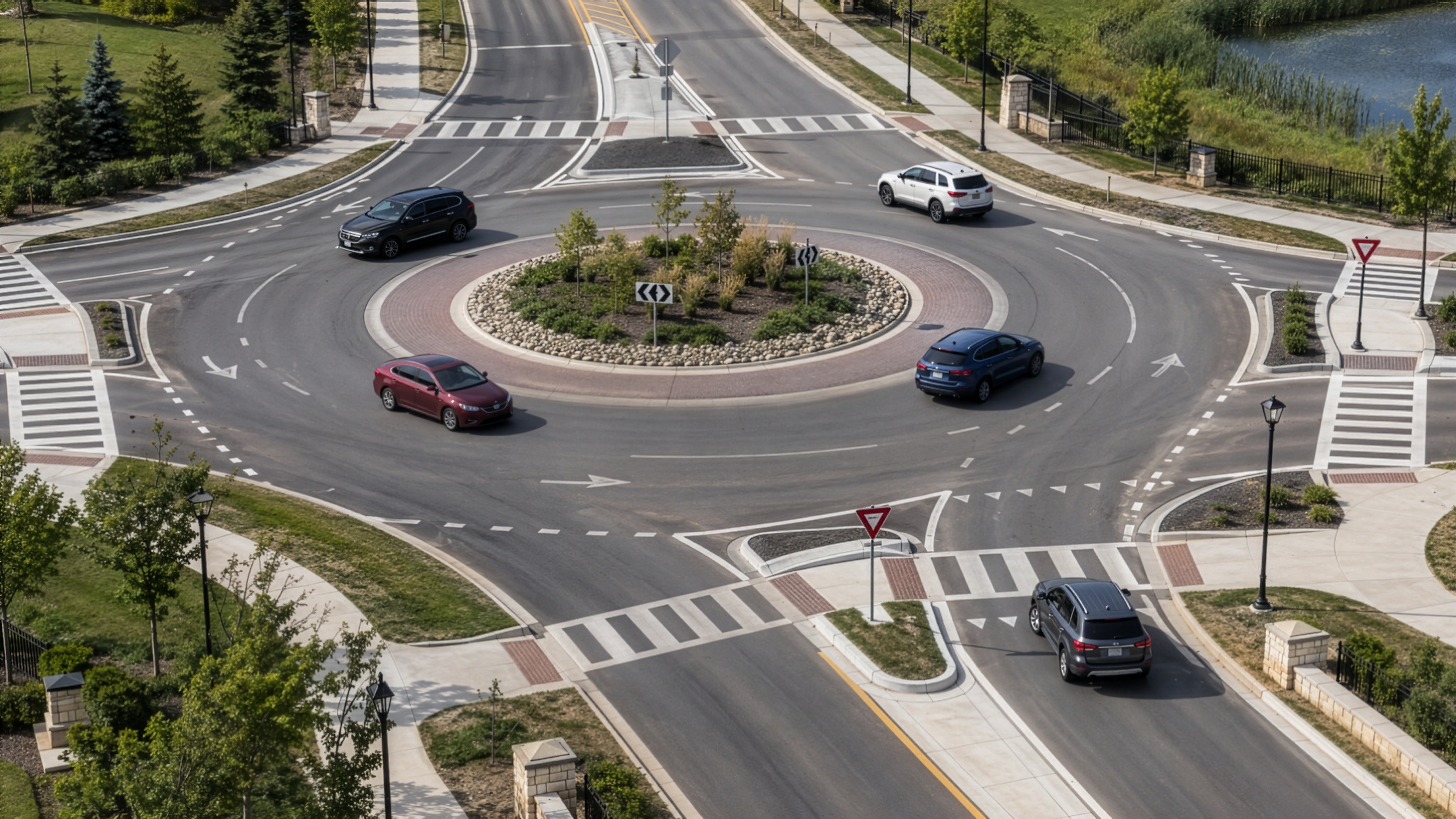
Roundabouts can look confusing when you are not used to them.
Several vehicles may be approaching at once, there may be multiple lanes, and drivers have to make decisions quickly.
But the basic idea is simpler than it looks:
Traffic entering the roundabout yields to traffic already circulating inside it.
Once you understand that rule, the rest becomes much easier.
Slow Down Before You Enter
A roundabout is not meant to be entered at normal roadway speed.
As you approach, reduce your speed and look for:
- yield signs,
- lane-use signs,
- pedestrians near crosswalks,
- vehicles already inside the roundabout,
- and the exit you plan to take.
Slowing down gives you time to understand the traffic pattern before entering.
Who Has the Right-of-Way?
Vehicles already circulating in the roundabout generally have the right-of-way.
Drivers entering the roundabout must yield to them.
That means you should not force your way into a small gap and expect circulating traffic to stop for you.
Wait until there is enough space to enter safely.
Do You Have to Stop Before Entering?
Not necessarily.
A yield sign does not automatically mean stop.
If the roundabout is clear and there is enough space to enter safely, you may continue without making a complete stop.
If traffic is approaching or already circulating, slow down or stop as needed and wait for a safe opening.
Look Left Before Entering
In a standard American roundabout, traffic circulates counterclockwise.
That means vehicles already inside the roundabout usually approach from your left.
Check left for circulating traffic before entering.
Do not focus so heavily on the left that you forget pedestrians or cyclists near the entrance.
Choose the Correct Lane Before You Enter
Multi-lane roundabouts require more planning.
Lane-use signs and pavement arrows usually tell you which lane to use for each exit.
In general, depending on the specific roundabout design:
- the right lane may serve right turns and straight-through movements,
- the left lane may serve straight-through or left-side exits,
- and some lanes may allow multiple movements.
Always follow the actual signs and lane markings at that roundabout.
Do not assume every roundabout uses exactly the same lane pattern.
Do Not Change Lanes Inside Unless the Markings Require It
One of the most common mistakes is entering in the wrong lane and then trying to fix the problem inside the roundabout.
Sudden lane changes inside a roundabout can surprise other drivers.
Choose the correct lane before entering and follow the lane markings through the circle.
If you miss your exit, it is usually safer to continue around again rather than cutting across another lane.
Use Your Turn Signal When Exiting
Signaling your exit helps other drivers understand what you are doing.
Use your right turn signal as you prepare to leave the roundabout.
This is especially helpful to drivers waiting to enter because they can better judge whether you are continuing around or leaving.
Do Not Stop Inside the Roundabout Without a Reason
Once you are circulating, keep moving unless traffic conditions require you to stop.
Stopping unnecessarily inside the roundabout can create confusion and may cause a rear-end collision.
Remember that entering vehicles are supposed to yield to you.
You generally should not stop to wave another vehicle into the roundabout.
Do Not Wave Drivers In
Trying to be polite can actually create confusion.
If you are already inside the roundabout and stop to let someone enter, drivers behind you may not expect it.
The entering driver may also hesitate because the normal rule says they should yield.
Following the established right-of-way rules is usually safer than inventing your own.
Watch for Pedestrians at the Crosswalks
Crosswalks are usually positioned near the entrances and exits rather than in the center of the roundabout.
Drivers should watch for pedestrians before entering and again when exiting.
A driver preparing to exit may be focused on surrounding vehicles and fail to notice someone entering the crosswalk.
Slow down enough to scan the entire exit area.
Large Trucks May Need More Than One Lane
Tractor-trailers and other large vehicles may need additional space to travel through a roundabout.
Some roundabouts include a raised truck apron around the center island that allows the trailer's rear wheels to track farther inward.
Do not try to squeeze beside a large truck inside the roundabout.
Give it extra room and allow it to complete the maneuver.
Motorcycles and Bicycles Can Be Harder to See
Smaller road users can be easier to overlook while you are watching several vehicles at once.
Before entering, check carefully for motorcycles and bicycles already circulating.
Give cyclists extra room and avoid passing them aggressively inside the roundabout.
What If You Miss Your Exit?
Do not panic.
Do not stop suddenly.
Do not cut across another lane.
Continue around the roundabout and take the exit the next time around when it is safe.
A missed exit costs only a few seconds.
A sudden lane change can create a crash.
Roundabouts Are Different From Traffic Circles
The terms are sometimes used interchangeably, but modern roundabouts usually have specific design features.
They typically include:
- yield control at entries,
- slower entry speeds,
- traffic circulating around a central island,
- and roadway geometry designed to reduce high-speed conflicts.
Older traffic circles may operate differently.
Always follow the signs and markings at the actual intersection rather than relying only on what you remember from another location.
Why Roundabouts Can Reduce Serious Crashes
Traditional intersections can create high-speed crossing and head-on conflict points.
Roundabouts reduce many of those conflicts because vehicles generally move in the same direction around the center island and enter at lower speeds.
That does not mean crashes are impossible, but the roadway design can reduce the types of high-speed collisions associated with conventional intersections.
Why Drivers Get Nervous Around Roundabouts
Much of the confusion comes from unfamiliarity.
Drivers may:
- stop when they do not need to,
- enter without yielding,
- choose the wrong lane,
- change lanes suddenly,
- or forget to signal when exiting.
These mistakes become less likely once drivers understand the basic pattern.
The Simple Rule to Remember
If you remember only one thing, remember this:
Yield before entering. Keep moving while circulating. Signal when exiting.
Everything else builds around those three steps.
The Bottom Line
Roundabouts are not designed to confuse drivers.
They are designed to keep traffic moving at lower speeds while reducing certain types of intersection conflicts.
Approach slowly, choose the correct lane, yield to vehicles already circulating, follow the markings, and signal when you exit.
And if you miss your exit, simply go around again.
A few extra seconds around the circle are much safer than a last-second lane change.
Comments
No comments yet. Be the first to join the discussion.
Leave a Comment
Your email will not be displayed publicly. Comments are reviewed before publication.