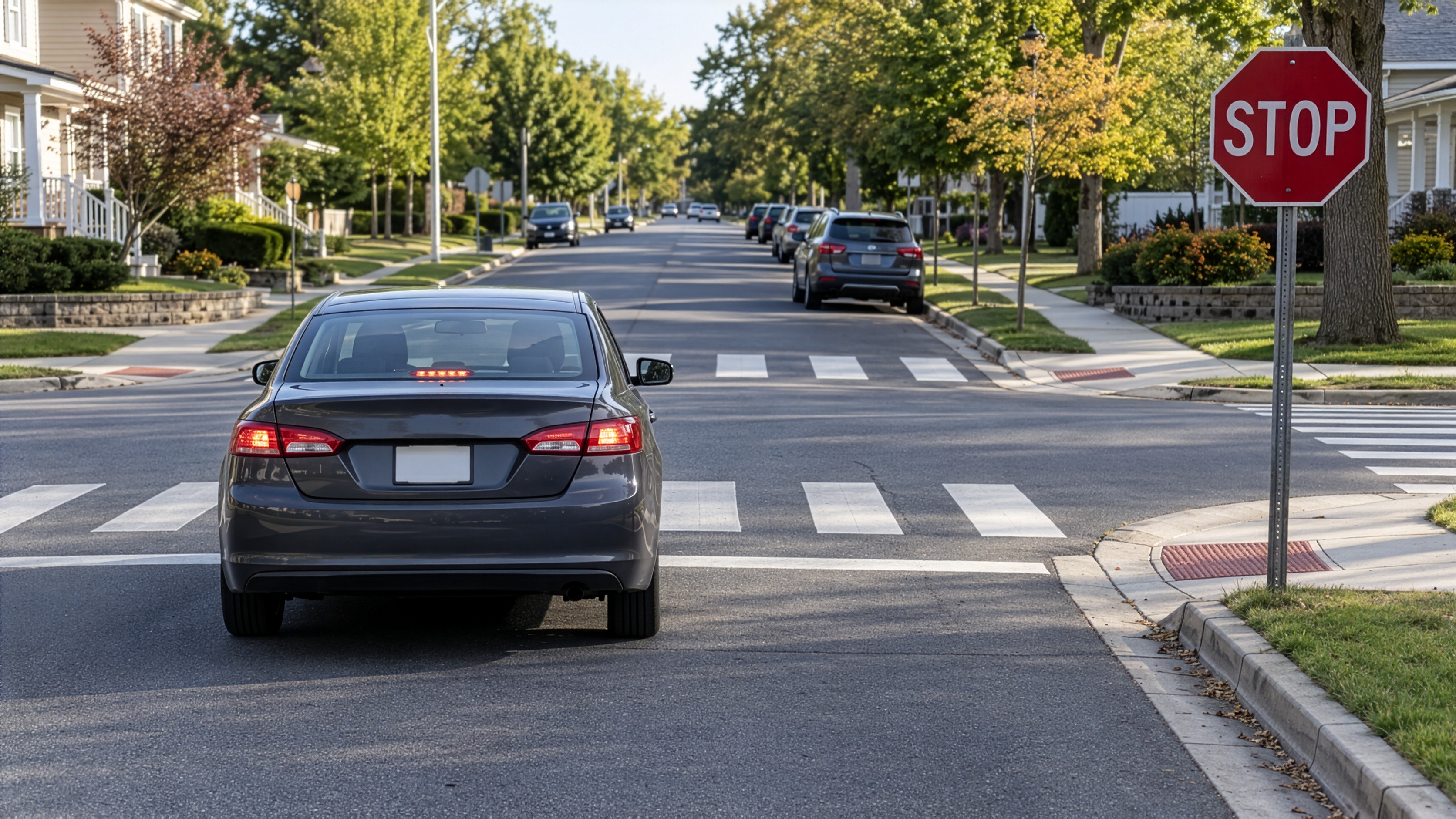
You approach a stop sign.
No cars appear to be coming. No pedestrians are nearby. The intersection looks completely clear.
So instead of stopping, you slow to a few miles per hour, glance both ways, and keep moving.
Many drivers call that a rolling stop.
It may feel almost the same as stopping, but legally and practically, it is not.
A stop sign means exactly what it says: stop.
Yes, You Actually Have to Stop
At a stop sign, slowing down is not enough.
The vehicle should come to a complete stop before entering the intersection.
In Virginia, the law requires a driver approaching a stop-controlled intersection to stop at the marked stop line. If there is no stop line, the driver must stop before entering the crosswalk. If there is no marked crosswalk, the stop must be made at the point nearest the intersecting roadway where the driver can see approaching traffic.
Only after stopping should the driver proceed when it is safe and after yielding to traffic that has the right-of-way.
What Counts as a Complete Stop?
A complete stop means the vehicle is no longer moving.
The wheels should stop rotating before you proceed.
There is no need to sit at the sign for an arbitrary number of seconds when the intersection is clear, but the vehicle must actually stop.
Slowly creeping through the intersection without ever reaching zero speed is still a rolling stop.
Where Are You Supposed to Stop?
The proper stopping point is important because stopping too far forward can put your vehicle into a crosswalk or into the path of crossing traffic.
The general order is:
- stop at the marked stop line,
- if there is no stop line, stop before the crosswalk,
- if there is no marked crosswalk, stop before entering the intersection where you can safely observe approaching traffic.
Sometimes the first legal stopping point does not provide a clear view around buildings, vegetation, parked vehicles, or other obstructions.
In that situation, stop first where required, then carefully move forward as necessary to improve your view before entering the intersection.
Why Rolling Stops Are Riskier Than They Look
A driver making a rolling stop often believes the intersection is clear.
The problem is that a quick glance does not always reveal everything approaching the intersection.
Potential hazards include:
- pedestrians entering a crosswalk,
- children on bicycles,
- motorcycles that are harder to notice,
- vehicles hidden by parked cars,
- another driver who also fails to stop,
- or a vehicle approaching faster than expected.
A complete stop gives you additional time to observe the intersection instead of trying to process everything while the vehicle is still moving.
The Stop Sign Is Not Only About Other Cars
Drivers sometimes focus so heavily on cross traffic that they forget about pedestrians.
A stop-controlled intersection may include a crosswalk before the intersection itself.
If you roll beyond the stop line while looking left for vehicles, you may enter the exact space a pedestrian is using to cross.
This is particularly important in neighborhoods, near schools, downtown areas, parking lots, and other places where people may be walking close to traffic.
What Happens at a Four-Way Stop?
Four-way stops create another common source of confusion.
The general practice is that the driver who arrives and stops first proceeds first.
When two vehicles arrive at approximately the same time, drivers should use caution and follow applicable right-of-way rules rather than trying to force their way through the intersection.
Communication and predictability matter.
If another driver has clearly begun entering the intersection, attempting to beat them through usually creates more risk than simply waiting another moment.
What If Another Driver Waves You Through?
Drivers sometimes wave another vehicle through even when the right-of-way situation is unclear.
A friendly wave can help communicate intention, but it does not replace your responsibility to make sure the intersection is safe.
Do not proceed simply because someone gestures for you to go.
Check every direction yourself.
The person waving may not see another vehicle, pedestrian, bicycle, or motorcycle approaching from somewhere else.
Do You Have to Stop If Nobody Is Around?
Yes.
A stop sign does not become optional because the intersection appears empty.
Traffic-control devices are designed to create predictable behavior.
If drivers decide individually when a stop sign is necessary, other road users can no longer reliably predict what those drivers will do.
Predictability is one of the foundations of safe traffic movement.
Why Do So Many Drivers Roll Through Stop Signs?
For many people, it becomes a habit.
If a driver uses the same quiet intersection every day and rarely sees another vehicle there, they may gradually stop treating the sign seriously.
Others may be:
- in a hurry,
- distracted,
- following the vehicle ahead too closely,
- assuming nobody is coming,
- or simply copying what other drivers commonly do.
The danger is that familiar roads can create false confidence.
An intersection that has been empty a hundred times can still have a pedestrian, cyclist, or vehicle approaching the next time you reach it.
Be Especially Careful in Residential Areas
Stop signs in neighborhoods deserve extra attention.
Residential streets may include:
- children entering the road unexpectedly,
- people walking dogs,
- cyclists,
- vehicles backing out of driveways,
- parked cars blocking visibility,
- and intersections with limited sight distance.
Rolling through a stop sign may save only a second or two while reducing the amount of time available to notice one of those hazards.
What About Stop Signs in Parking Lots?
Parking lots can be confusing because traffic controls may exist on private property and the legal rules can vary by location and circumstance.
Regardless of enforcement details, treating clearly posted stop signs seriously is usually the safest approach.
Parking lots combine vehicles, pedestrians, backing cars, shopping carts, and limited visibility in a relatively small area.
A complete stop gives you time to see what is happening around you.
A Stop Sign Is Also a Chance to Reset
There is another benefit to making a real stop that drivers rarely think about.
It briefly interrupts the rush of driving.
You get a moment to:
- look left,
- look right,
- check for pedestrians,
- check the intersection again,
- and decide whether it is safe to proceed.
That small pause can prevent the kind of mistake that happens when someone assumes the road is clear instead of confirming it.
The Bottom Line
A stop sign does not mean slow down and continue if everything looks clear.
It means stop.
Come to a complete stop at the correct location, check the intersection carefully, yield where required, and proceed when it is safe.
The difference between a rolling stop and a full stop may only be a second or two.
But that second can give you enough time to notice the person, bicycle, motorcycle, or vehicle you did not see on your first glance.
When the sign says stop, make the stop real.
Comments
No comments yet. Be the first to join the discussion.
Leave a Comment
Your email will not be displayed publicly. Comments are reviewed before publication.