You see a sign that says a lane is ending ahead.
Most drivers immediately move into the open lane.
Then another driver continues past the line of cars in the closing lane and waits until the very end to merge.
To many people, that looks like cutting in line.
But in heavy traffic, that late merge may actually be exactly what transportation agencies want drivers to do.
That technique is called a zipper merge.
What Is a Zipper Merge?
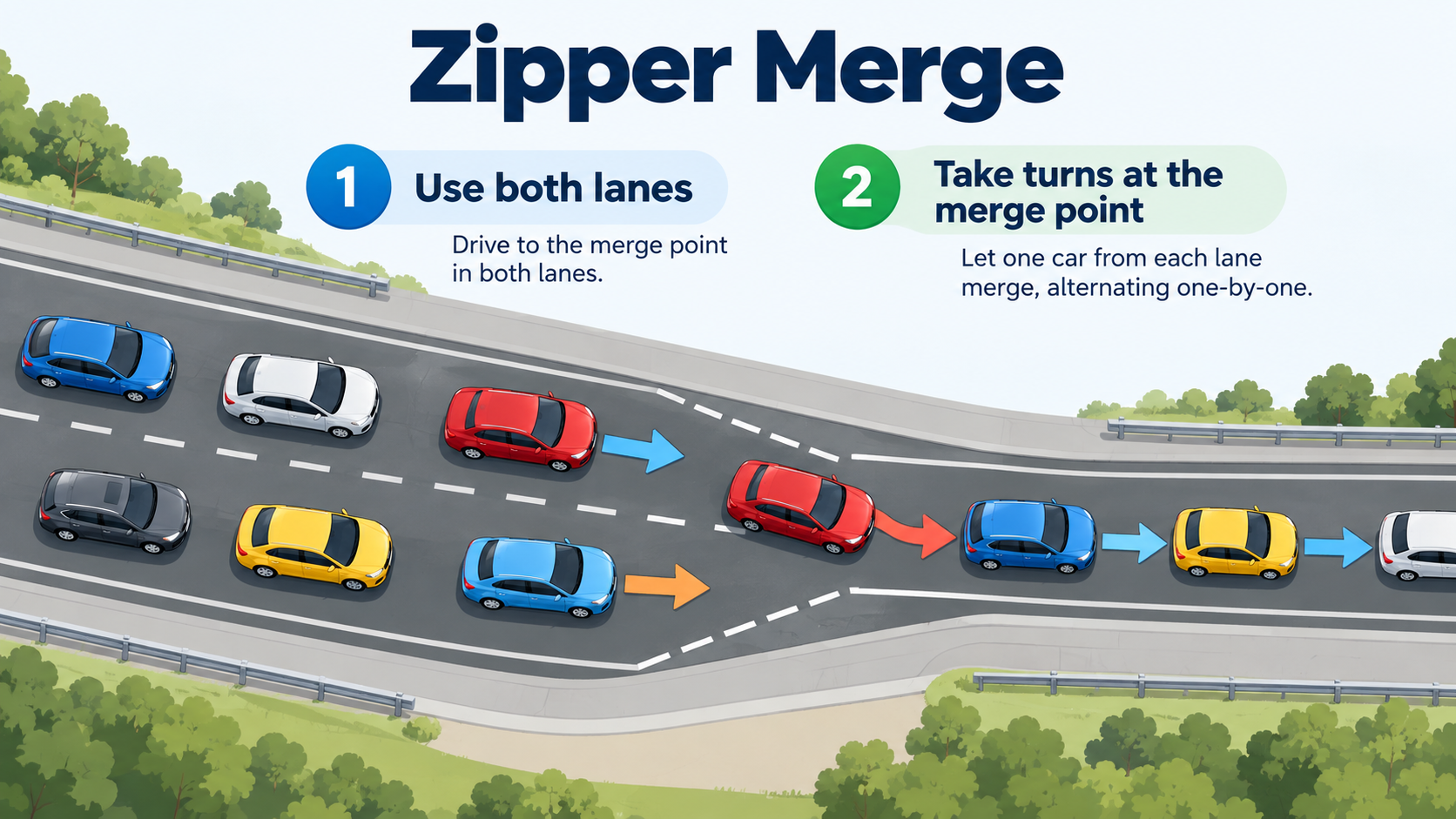
A zipper merge happens when drivers continue using both lanes until they reach the actual merge point, then alternate one vehicle at a time into the remaining lane.
The pattern looks like the teeth of a zipper coming together:
- one vehicle from the continuing lane,
- one vehicle from the ending lane,
- then another from the continuing lane,
- then another from the ending lane.
The Minnesota Department of Transportation describes the zipper merge as using both lanes until the defined merge area, then alternating into the open lane. The agency recommends this approach when traffic is heavy and slow.
Read MnDOT's zipper merge guidance.
Why Does It Feel Like Someone Is Cutting the Line?
Because most drivers were taught to merge as soon as they see a lane-closed-ahead sign.
Once a long line forms in the open lane, anyone who continues driving in the empty lane appears to be skipping everyone who already moved over.
That creates a fairness problem.
The early mergers think:
“I got in line when I was supposed to. Why should that driver get to pass everyone?”
The late merger may be thinking:
“The lane is still open. I am supposed to use it until the merge point.”
Both drivers can believe they are doing the right thing.
Why Use Both Lanes?
When traffic is already backed up, filling both lanes makes better use of the available roadway.
Instead of creating one extremely long line, traffic is divided between two shorter lines until the merge point.
MnDOT says zipper merging can reduce the overall length of a backup by as much as 40 percent. It can also reduce speed differences between lanes and reduce congestion near interchanges.
That does not mean more vehicles can magically pass through a one-lane work zone at once. The bottleneck still exists.
The benefit is in how traffic approaches that bottleneck.
The Real Goal Is Reducing Speed Differences
One of the biggest problems with early merging is the large speed difference that can develop between lanes.
The open lane may be nearly stopped while the closing lane remains mostly empty.
Now you have:
- one lane crawling,
- one lane moving much faster,
- drivers suddenly changing lanes,
- and growing frustration between motorists.
When both lanes are being used and traffic is moving at similar speeds, those differences are reduced.
That can make the merge point more predictable.
Are You Really Supposed to Wait Until the Lane Ends?
When traffic is heavy and slow, that is often the idea behind a zipper merge.
MnDOT advises drivers to continue using both lanes until the merge point when traffic is backing up, then take turns entering the open lane.
But there is an important distinction:
A zipper merge is not always the best strategy when traffic is flowing freely at highway speed.
When traffic is light and vehicles are moving normally, merging earlier can make more sense because drivers can move into the continuing lane without creating a last-second high-speed maneuver.
MnDOT makes that distinction in its guidance: use both lanes during heavy, slow traffic, but when there is no backup and traffic is moving at highway speed, moving over earlier can be appropriate.
So Should You Merge Early or Late?
If traffic is light and moving normally
Merge when you have a safe opening.
There is little benefit to racing to the end of an empty lane when traffic is already flowing smoothly.
If traffic is heavy and backed up
Continue using both lanes to the merge point and alternate vehicles there.
That is the situation where the zipper merge provides the greatest benefit.
What Does “Take Turns” Actually Mean?
At the merge point, drivers should cooperate.
The ideal pattern is approximately:
one car from the open lane, then one car from the ending lane.
The next pair does the same thing.
No driver should need to force their way into a tiny gap, and the continuing-lane driver should not accelerate simply to prevent another vehicle from merging.
The technique only works well when both lanes cooperate.
Should You Block the Empty Lane?
No.
Some drivers become frustrated with people using the closing lane and move partially into that lane to prevent anyone from passing.
That creates another problem.
If traffic management signs or conditions call for both lanes to be used, blocking one lane defeats the purpose of the merge pattern.
It can also create an unnecessary confrontation between drivers.
The better approach is to stay in your lane, keep a safe following distance, and allow the merge to happen at the designated point.
What If Nobody Lets You In?
Do not force your vehicle into another lane.
Slow down, signal, and look for a safe opening.
The zipper pattern depends on cooperation, but safety still comes first.
If another driver refuses to allow a merge, it is better to wait for the next safe opportunity than create a collision trying to prove who has the right of way.
Does the Zipper Merge Eliminate Traffic?
No.
A lane closure reduces road capacity, so congestion may still occur.
The zipper merge does not make the bottleneck disappear.
What it can do is organize the queue more efficiently, reduce the physical length of the backup, and reduce the speed imbalance between lanes.
That can matter when a long backup would otherwise extend into another interchange, intersection, or ramp.
Why Do Drivers Resist It?
The biggest obstacle may not be engineering. It may be psychology.
People generally dislike watching someone move ahead of them after they have already waited in line.
A zipper merge challenges the idea that the roadway should operate like a supermarket checkout line.
But highways are not checkout lines.
Two open lanes are two available traffic lanes until signs, markings, or the roadway configuration require them to become one.
Signs Matter
Drivers should always follow posted instructions.
Some work zones specifically display messages such as:
- USE BOTH LANES
- TAKE TURNS AT MERGE
- MERGE HERE
Transportation agencies may use these signs when traffic conditions make a late or zipper merge desirable.
What About Drivers Who Fly Down the Empty Lane?
Using the open lane is one thing. Driving aggressively is another.
A zipper merge does not mean:
- speeding past slow traffic,
- passing on the shoulder,
- cutting across solid markings,
- forcing into a nonexistent gap,
- or ignoring work-zone speed limits.
Drivers should use the available lane at a safe speed that matches conditions, then merge cooperatively.
The Zipper Merge in One Sentence
When traffic is backed up, use both lanes until the merge point and then take turns.
When traffic is light and moving normally, merge when you have a safe opportunity instead of creating an unnecessary last-second maneuver.
Why This Matters
Zipper merging is a good example of why driving behavior can create conflict even when people believe they are helping traffic.
Early mergers may believe they are being courteous.
Late mergers may be following the traffic-management strategy exactly as intended.
The conflict usually comes from drivers following different expectations.
Clear signs, predictable driving, and cooperation are what make the system work.
The next time you see two lanes becoming one during a backup, remember the basic idea:
Use the available road. Take turns at the merge. Keep traffic moving.